


Product Description
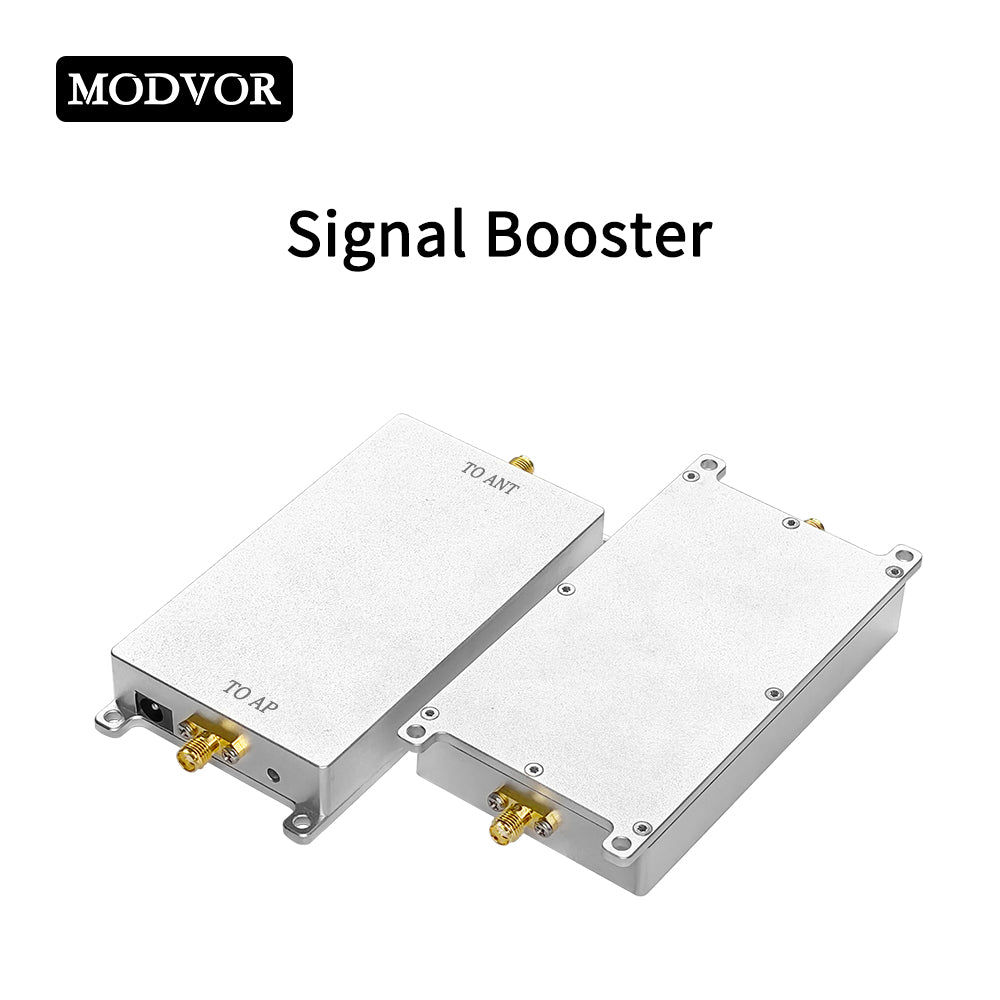
The 5.2GHz (5150-5350MHz) band delivers wider channels and cleaner spectrum than 2.4GHz, making it ideal for Wi-Fi 6/6E, UAV video downlinks, and point-to-point bridges. But higher frequencies also suffer greater path loss—so when a 10W booster isn’t enough, this 20W signal booster steps in. It amplifies both directions of the link with 43dBm (20W) output, 20dB TX gain, and 18dB RX gain, adding roughly 3dB of extra margin to keep your data and video streams stable where they would otherwise fade. Running on 12-24V DC, it uses SMA female connectors and fits into a compact 118 × 59 × 17 mm aluminum enclosure weighing just 0.2 kg. The standard 5.5 × 2.1 mm power jack keeps field power simple and flexible.
Typical Applications
- Wi-Fi 6/6E Infrastructure: Boost access point signals for enterprise, campus, and outdoor coverage
- UAV Video & Data Links: Extend 5GHz downlink range for professional drone operations
- Point-to-Point Microwave Backhaul: Strengthen long-distance wireless bridges for telecom and enterprise
- Public Safety & Emergency Comms: Reliable two-way links for critical operations in remote areas
- Industrial IoT & SCADA: Two-way data transmission for remote sensors and controllers
- Amateur Radio & Field Testing: Higher output for licensed 5GHz experimentation and validation
Technical Specifications
|
Parameter |
Value |
|
Pout/dBm |
43 dBm (20W) |
|
Working Frequency |
5150 – 5350 MHz |
|
TX Gain (S21) |
20 dB |
|
RX Gain (S21) |
18 dB |
|
DC Supply |
12 – 24 V |
|
Connector |
SMA Female |
|
Size |
118 × 59 × 17 mm |
|
Weight |
0.2 kg |
|
Power Socket |
5.5 × 2.1 mm |
Key Advantages
Doubling the output from 10W to 20W yields roughly 3dB of additional link margin—a meaningful gain in the 5GHz band, where obstacles and distance take a heavier toll than at lower frequencies. The 43dBm transmit power pushes your signal farther through open air and light obstructions, while the 18dB receive gain ensures weak return signals are amplified cleanly. That symmetry keeps two-way links balanced for telemetry, video, and data applications.
Power flexibility remains a core strength: the 12-24V DC input accepts 3S-6S LiPo packs, vehicle electrical systems, and solar-charged battery banks. The 5.5 × 2.1 mm power jack is common in field equipment, and the SMA female ports connect directly to standard antennas and coax. The aluminum housing provides passive cooling and mechanical protection, and at just 0.2 kg it adds negligible weight to a drone or portable ground station.
Tuned specifically for 5.15-5.35GHz, this booster covers the lower UNII-1 band used by Wi-Fi 6/6E, outdoor bridges, and UAV video links. If you’ve been running a 10W unit and still experiencing dropouts or range limits, stepping up to 20W is a practical way to regain margin without changing your entire RF chain.
What's in the Box
- 1 × 5.2GHz 20W Signal Booster